
Growth vs Value Investing: Understanding the Key Differences
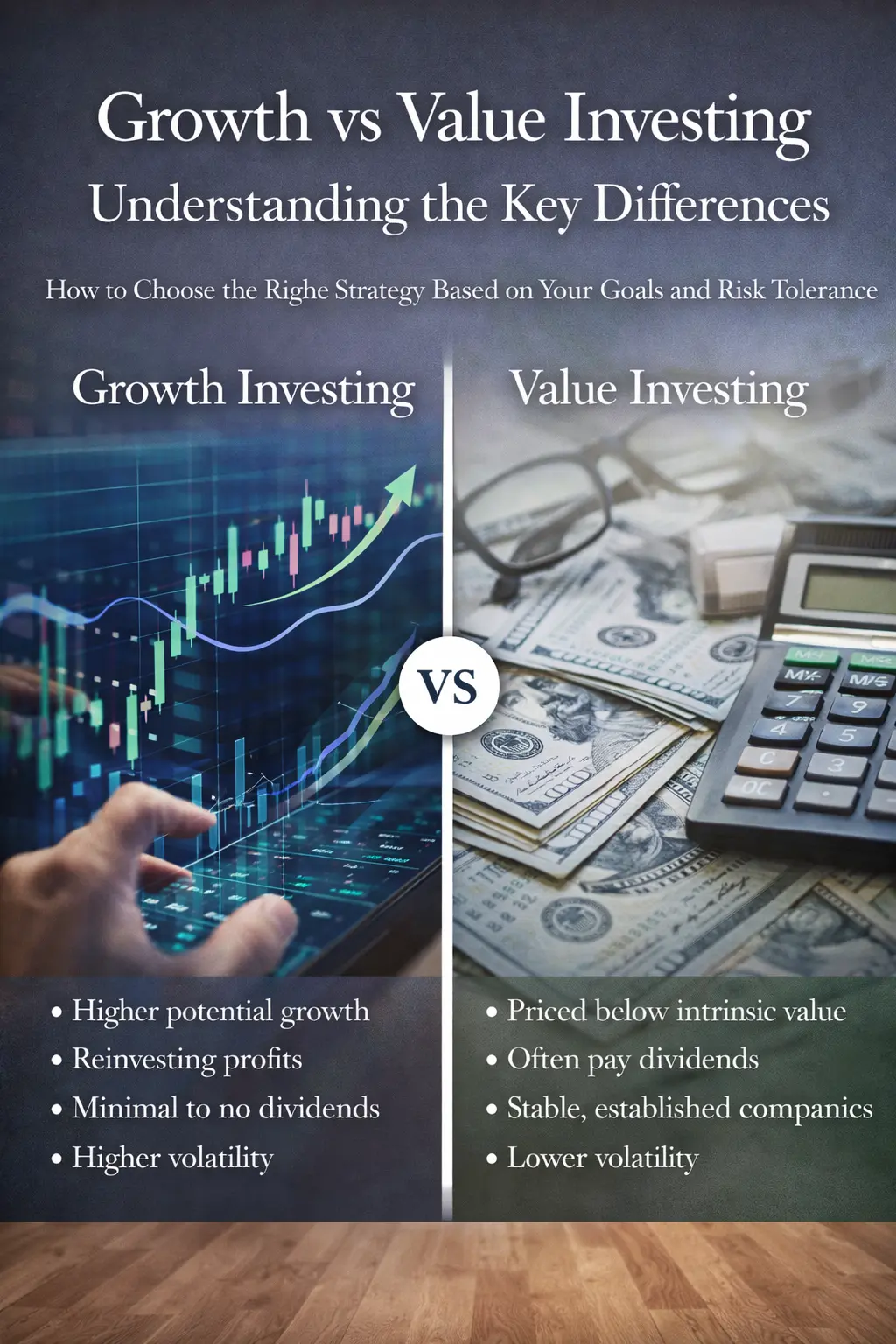
Growth vs Value Investing: Understanding the Key Differences
How to Choose the Right Strategy Based on Your Goals and Risk Tolerance
When it comes to investing, your strategy should align with your financial goals, timeline, and comfort with risk.
Two of the most common approaches are growth investing and value investing. While both aim to build wealth over time, they do so in very different ways.
Many investors benefit from a mix of both, but understanding how each works can help you make more confident decisions.
What Is Growth Investing?
Growth investing focuses on companies expected to grow faster than the overall market.
These companies typically:
- Reinvest profits back into the business instead of paying dividends
- Operate in innovative or expanding industries
- Show strong revenue and earnings growth potential
Because of this expected growth, these stocks often trade at higher valuations, meaning they can appear expensive compared to traditional metrics.
💡 Examples often include technology, healthcare innovation, and emerging industries.
What Is Value Investing?
Value investing focuses on companies that appear undervalued compared to their true worth.
These companies may:
- Be temporarily out of favor
- Have experienced recent setbacks
- Be overlooked by the broader market
Value investors look for opportunities to buy strong companies at lower prices, expecting the market to eventually recognize their true value.
Many value stocks also:
- Pay dividends
- Have more established business models
- Offer steady, long-term performance
How Investors Evaluate Growth vs Value Stocks
Growth Stocks
- Higher price-to-earnings ratios
- Higher price-to-sales ratios
- Faster revenue and earnings growth
- Lower or no dividend payouts
Value Stocks
- Lower price-to-earnings ratios
- Lower price relative to fundamentals
- Slower but more stable growth
- Often pays dividends
Performance in Different Market Conditions
Growth and value investments tend to perform differently depending on the market environment.
- Growth stocks often perform well during strong economic expansion and rising markets
- Value stocks may perform better during market corrections or periods of uncertainty
- Value stocks can also provide income through dividends
💡 Market cycles shift, which is why many investors hold a combination of both strategies.
Understanding Risk and Time Horizon
Growth Investing Risk
- Higher volatility
- Prices depend heavily on future expectations
- Requires a longer time horizon
Value Investing Risk
- A stock may remain undervalued longer than expected
- Some companies may be “cheap for a reason.”
Both strategies carry risk, but in different ways.
Which Strategy Is Right for You?
There is no one-size-fits-all answer.
Consider:
- Your investment timeline
- Your comfort with market fluctuations
- Whether you prefer growth potential or steady income
Many investors choose a balanced approach, combining both growth and value investments to diversify risk and opportunity.
Final Thoughts
Understanding the difference between growth and value investing can help you build a more intentional and resilient portfolio.
The most important step is not choosing one over the other, but investing with a clear strategy and long-term perspective.
💬 As always, it is wise to consult with a financial advisor before making investment decisions, especially as markets and economic conditions evolve.
Categories
Recent Posts